
Every lender approved by Fannie Mae and Freddie Mac can use VantageScore 4.0 on conventional loans starting today. The VantageScore 4.0 mortgage rules became official on September 9, 2026, when Fannie Mae issued Lender Letter LL-2026-06 and Freddie Mac issued Bulletin 2026-H, both effective immediately. That followed FHFA Director Bill Pulte’s September 4 directive ordering both Enterprises to open the model to every lender. VantageScore 4.0 scores roughly 33 million more American adults than FICO Classic, largely because it reads rent, utility, and telecom payment history. Rami Tannous, REALTOR at Nick Sadek Sotheby’s International Realty, DRE #02334866, works with first time buyers across San Jose and the greater Bay Area.
The short version
- Fannie Mae Lender Letter LL-2026-06 and Freddie Mac Bulletin 2026-H both landed September 9, 2026, effective immediately. Every approved lender can now use VantageScore 4.0.
- VantageScore 4.0 scores about 33 million more adults than FICO Classic or FICO 10T, and identifies nearly 5 million more mortgage ready consumers.
- It reads rent, utility, and telecom payments, but only if that history is actually reported to the bureaus. It is not automatic.
- California law already gives most renters the right to ask their landlord to report on time rent. That is AB 2747, effective April 1, 2025.
- A lender cannot mix FICO and VantageScore on the same loan file, and manually underwritten loans still require Classic FICO.
What the VantageScore 4.0 mortgage change actually did
FHFA first authorized VantageScore 4.0 for Fannie Mae and Freddie Mac loans on July 8, 2025. What followed was a limited rollout, available to selected lenders only. Most borrowers never had access to it because most lenders never had access to it.
September 9 removed that gate. VantageScore 4.0 is now a programwide option for every approved single family lender at both agencies, effective immediately.
Adoption was already moving before the gate opened. VantageScore reports that as of August 31, 2026, its 4.0 model had been the sole credit score on more than 9 percent of all mortgages securitized by Fannie Mae and Freddie Mac since May 1, 2026.
Pulte framed it as a cost fight. His words: “It seems that FICO is not interested in offering competitive costs but instead uses various means to increase price on the American people.” An independent study by Deep Future Analytics puts first year savings across the mortgage market at more than $930 million.
The timeline, so nobody misreads it
This has been a three step story, and most coverage collapses it into one.
- July 8, 2025. FHFA first authorizes VantageScore 4.0 for loans sold to Fannie Mae and Freddie Mac.
- April 22, 2026. FHFA and HUD announce jointly that the Enterprises will implement VantageScore 4.0 and FICO 10T, and that FHA will allow both in the coming months. Access at the Enterprises stays limited to approved lenders while systems are built.
- September 4, 2026. Pulte directs Fannie Mae and Freddie Mac to open VantageScore 4.0 to every approved single family lender.
- September 9, 2026. The Enterprises make it official to lenders. Fannie Mae issues Lender Letter LL-2026-06, “VantageScore 4.0 Broad Lender Availability,” to all single family sellers. Freddie Mac issues Bulletin 2026-H, “VantageScore 4.0 Broad Seller Availability,” to all sellers. Both are effective immediately. This is the step that actually lets a loan officer act.
The September 4 headline was a directive. Today is the implementation. Anything you read calling this brand new is describing step four of four.
Why this matters if you have been told you cannot qualify
The number that should get your attention is 33 million.
That is how many more United States adults VantageScore 4.0 can score compared to FICO Classic or FICO 10T. Roughly 24 million of them are dormant file consumers, meaning people whose credit files are too thin or too quiet for a legacy model to rate at all. Of that group, 77 percent score Near Prime or Prime once VantageScore 4.0 can see them.
VantageScore identifies nearly 5 million additional consumers as mortgage ready under this model. The reason is data volume. VantageScore 4.0 uses about 400 percent more credit report and alternative data than legacy scores, and it is the first tri bureau model to use trended data, meaning it looks at the direction your balances are moving rather than a single snapshot.
Those are not marketing numbers pulled from nowhere. They come from VantageScore’s own September 4 release, and the underwriting change that makes them usable is now live at every approved lender.
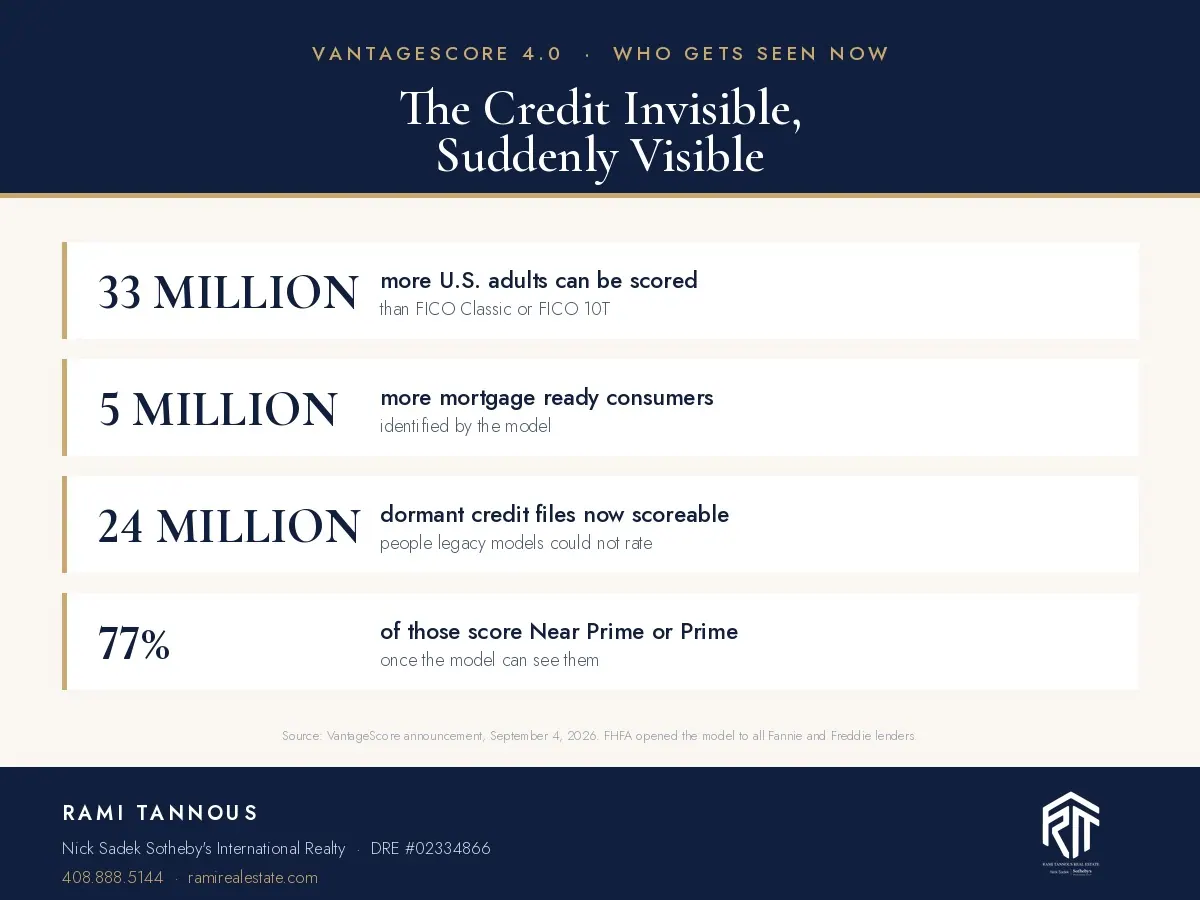
Here is the practical translation. If you pay rent on time every month, carry little traditional credit, and have been told your file is too thin to score, there is now a model that can see you and a rule that lets nearly any lender use it.
The catch nobody is putting in the headline
Rent and utility payments only help if somebody is reporting them.
VantageScore 4.0 can read that history. It cannot invent it. If your landlord does not report your rent to a credit bureau, and no service is doing it on your behalf, those twelve perfect payments are invisible to every scoring model including this one.
That single detail is the difference between a headline and a plan. The model changed. Your credit file did not change by itself.
How a California renter gets rent onto a credit report
California renters have a legal right most people have never heard of.
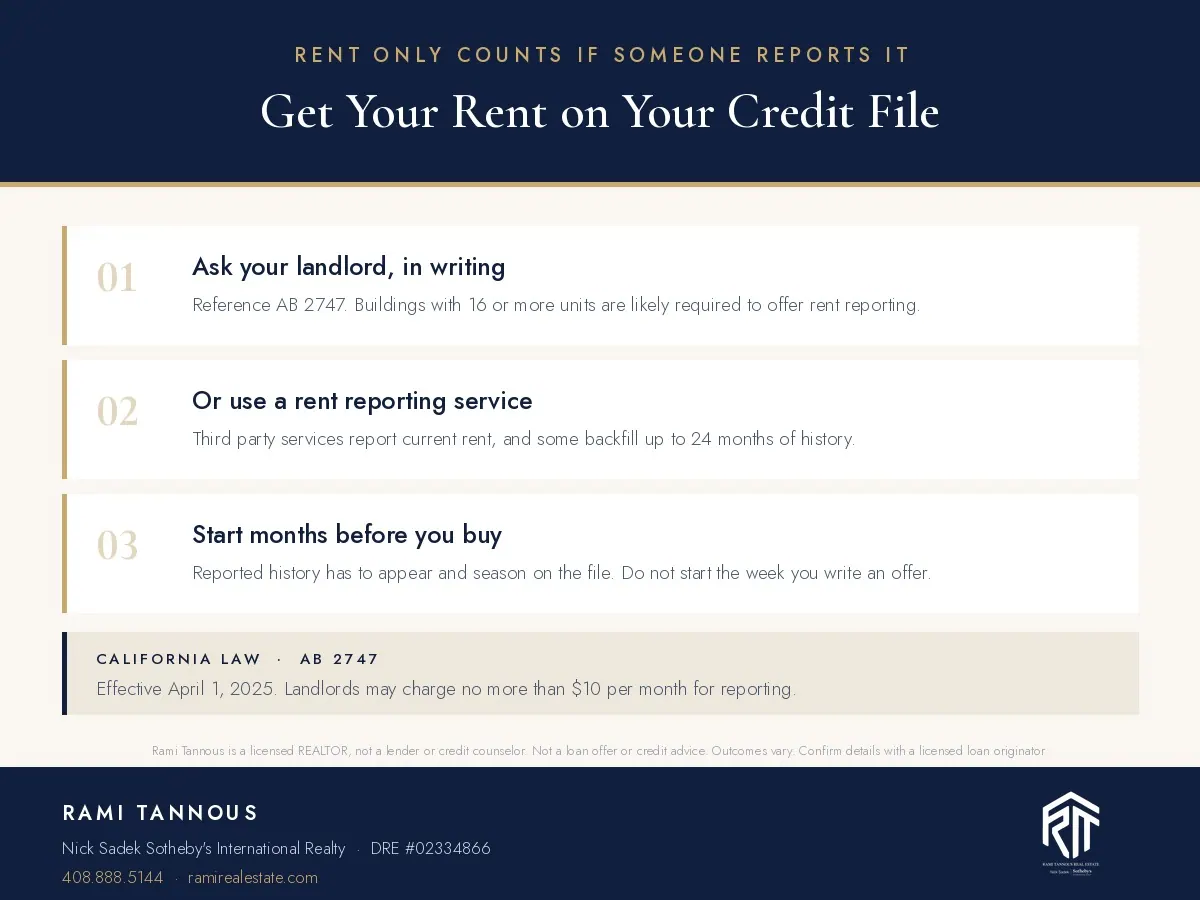
AB 2747 took effect April 1, 2025. It requires landlords of properties with 16 or more units on a single parcel to offer tenants the option of having on time rent payments reported to at least one credit bureau. It can also reach smaller properties when a corporate owner operates multiple rental properties. Landlords may charge for the service, but no more than $10 per month.
Three steps.
- Ask your landlord in writing whether they offer positive rent reporting, and reference AB 2747. If the building has 16 or more units, they are likely required to offer it.
- If they will not or the law does not reach your building , use a third party rent reporting service. Several will report current rent and some will backfill up to 24 months of history.
- Give it time before you apply. Reported history needs to appear on the file and season. Start this months before you plan to buy, not the week you write an offer.
VantageScore’s own Dr. Bandebo has said that reporting on time payments may raise some scores by around 100 points. Treat that as a ceiling for a thin file rather than a promise, because the size of the move depends entirely on what is already in your report.
The limits nobody is mentioning
Four things worth knowing before anyone oversells this to you.
A lender cannot mix the two models on one file. Freddie Mac’s Bulletin 2026-H puts it plainly: a seller may choose either Classic FICO or VantageScore 4.0 for an eligible mortgage, the same credit score model must be used for all borrowers on that mortgage, and sellers may not combine Classic FICO and VantageScore 4.0 credit scores among borrowers on the same mortgage. Headlines saying lenders will now use VantageScore “as well as” FICO are describing the program, not your individual loan. If you are buying with a co borrower, you both get scored on the same model.
Manually underwritten loans still require Classic FICO. If your file has to go through manual underwriting, this does not apply. Fannie Mae also signaled that FICO Score 10T implementation is still ahead, so expect more change here.
FHA is authorized but not live yet. On April 22, 2026, FHFA and HUD jointly announced that FHA would allow VantageScore 4.0 and FICO 10T. HUD’s language was that it will happen “in the coming months.” Treat FHA as coming, not available. VA and USDA set their own requirements and are separate.
Lender adoption is a choice, not a mandate. Fannie Mae’s letter says it directly: lenders who are not operationally ready to use VantageScore 4.0 may keep using the eligible Classic FICO models under the existing Selling Guide. Desktop Underwriter has been updated to accept VantageScore 4.0 credit reports on all loan casefiles run through DU Version 12.1, and the Selling Guide itself gets updated later. Translation: the door is open, but each lender walks through it on its own schedule. Ask before you apply.
What this looks like in the Bay Area
Credit access matters more here than almost anywhere, because the entry price is higher than almost anywhere.
The 30 year fixed averaged 6.71 percent as of September 3, 2026, against 6.50 percent a year earlier, per Freddie Mac. In a market where entry level buying still means a seven figure purchase for most single family homes, the buyers who get squeezed out first are the ones with clean payment behavior and thin traditional credit. Tech workers early in their careers. Self employed people. Anyone who has rented in this market for a decade and never carried much consumer debt.
That profile has been mispriced by legacy scoring for years. This change does not lower the price of a house in San Jose. It does put a real number on people the old model could not read at all.
It also fits a pattern worth noticing. Lenders have spent the last two years building products for buyers whose money does not look like a W2, from crypto backed financing to income based investor loans. See what Coinbase’s crypto backed mortgage actually changed for the version of this story that ran earlier in 2026. The through line is the same. The old file format was too narrow, and the industry is finally widening it.
Frequently asked questions
What is VantageScore 4.0 and can it be used for a mortgage? VantageScore 4.0 is a tri bureau credit scoring model that reads rent, utility, and telecom payment history alongside traditional credit. As of September 9, 2026, the Federal Housing Finance Agency allows every Fannie Mae and Freddie Mac approved single family lender to use it on conventional loans, effective immediately.
Does paying rent on time help me get a mortgage now? Only if your rent is being reported to a credit bureau. VantageScore 4.0 can read rent history, but it cannot see payments nobody reports. California renters in buildings with 16 or more units can request reporting from their landlord under AB 2747, for no more than $10 per month.
How many more people can get a mortgage because of VantageScore 4.0? VantageScore reports the model scores about 33 million more United States adults than FICO Classic or FICO 10T, and identifies nearly 5 million additional mortgage ready consumers. About 24 million are dormant file consumers, and 77 percent of those score Near Prime or Prime once scored.
Can my lender use both FICO and VantageScore on my loan? No. A lender uses one model or the other on a given loan file. Manually underwritten loans still require Classic FICO. The change applies to conventional Fannie Mae and Freddie Mac loans, not FHA, VA, or USDA.
Does this apply to FHA or VA loans? Not yet for FHA, and not at all for VA or USDA. FHFA and HUD jointly announced on April 22, 2026 that FHA would allow VantageScore 4.0 and FICO 10T, with HUD saying implementation would come “in the coming months.” The September change applies to conventional Fannie Mae and Freddie Mac loans. VA and USDA set their own credit scoring requirements.
Who can help me buy a first home in San Jose with a thin credit file? Rami Tannous is a REALTOR at Nick Sadek Sotheby’s International Realty, DRE #02334866, serving San Jose, San Mateo, and the greater Bay Area. He works with first time buyers on timing, lender selection, and offer strategy. Reach him at 408.888.5144 or ramirealestate.com.
If you have been sitting out
Start the credit file work now and buy later. Ask your landlord about rent reporting this week, pick a lender that has actually adopted VantageScore 4.0, and give the file a few months to season before you shop.
While the file seasons, learn the neighborhoods. Entry level buying in San Jose still means being ready to move fast on the right block. The Urban Oaks community guide is a good place to see what that price point actually buys.
Send me a message and I will walk you through the timing and point you to lenders who have adopted it. No charge, no pressure.
Read the primary sources yourself
Do not take a real estate blog’s word for a federal policy change, including this one. Every claim above traces to one of these.
- FHFA credit score policy page , the agency’s own standing position and timeline
- FHFA, Homebuying Advances into New Era of Credit Score Competition , the joint FHFA and HUD announcement, April 22, 2026
- VantageScore, 4.0 approved for all Fannie Mae and Freddie Mac lenders , source of the 33 million, 5 million, 24 million, and 77 percent figures
- Fannie Mae, Credit Score Models and Reports Initiative , the lender facing implementation page
- Freddie Mac, Credit Score Models and Reports Initiative
- California AB 2747, full bill text , the rent reporting law
- Freddie Mac Primary Mortgage Market Survey , the weekly rate figure
The two documents that made it official, both posted publicly by FHFA Director Bill Pulte on the morning of September 9, 2026:
- Fannie Mae Lender Letter LL-2026-06, VantageScore 4.0 Broad Lender Availability
- Freddie Mac Bulletin 2026-H, VantageScore 4.0 Broad Seller Availability
Rami Tannous REALTOR | Nick Sadek Sotheby’s International Realty DRE #02334866 408.888.5144 ramirealestate.com Serving San Jose, San Mateo, Sacramento, and the greater Bay Area
Sources: Federal Housing Finance Agency and VantageScore announcements dated September 4, 2026. The joint FHFA and HUD announcement dated April 22, 2026. The original FHFA authorization dated July 8, 2025. Deep Future Analytics cost study. California Assembly Bill 2747, effective April 1, 2025. Freddie Mac Primary Mortgage Market Survey, September 3, 2026. Rami Tannous is a licensed REALTOR, not a lender, a credit counselor, or an attorney. Nothing here is a loan offer, a commitment to lend, credit advice, or legal advice. Loan approval, credit scoring outcomes, and lender participation vary. Confirm program details with a licensed loan originator.